The quick version
- Drive your own team of Alaskan huskies across snow-covered trails outside Tromsø. Includes a traditional lunch and lasts 4 hours.[1]
- From US$355 per person. Book immediately and pay afterwards, with complimentary cancellation until 24 hours before.[1]
- Dog sledding on snow runs from November to April, depending on snow conditions.[2]
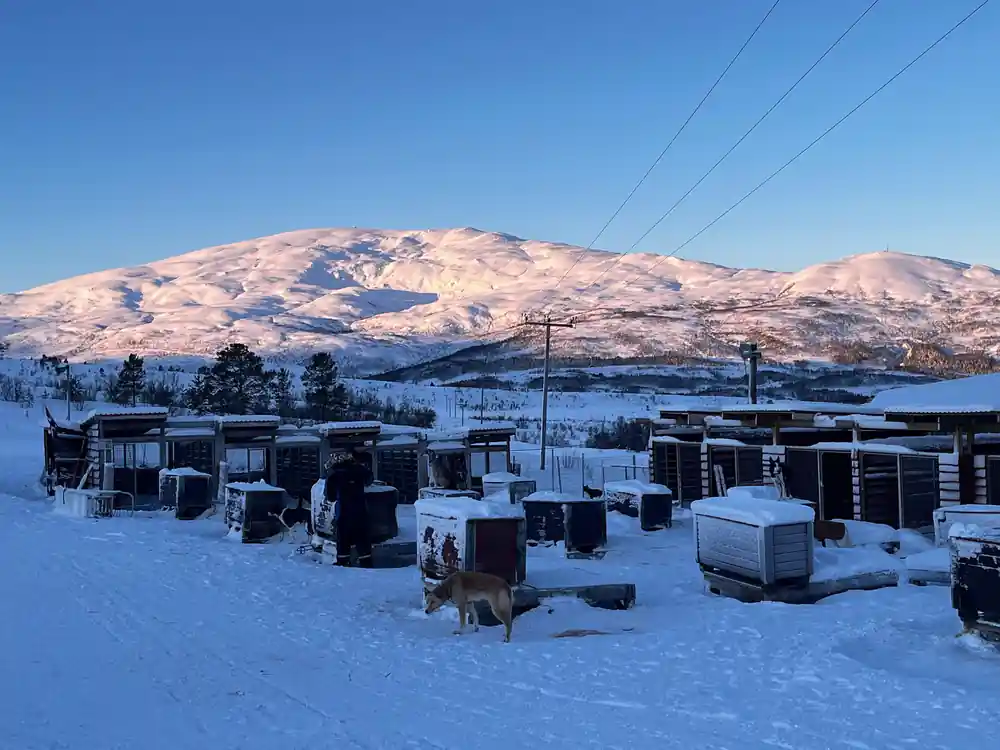
- The centre is on Kvaløya, west of Tromsø. A staffed kennel and camp give a working feel, not a zoo.[2]
- You'll ride or drive on packed trails, with time at the camp. Warm clothing and sensible boots make the difference.
| Self-Drive | Guided Ride | Husky Hike | |
|---|---|---|---|
| From | from US$355[1] | from US$358[3] | from US$172[4] |
| Duration | 4 hours[1] | 4 hours[3] | 4.5 hours[4] |
| Rating (GetYourGuide) | 4.86[1] | 4.87[3] | 4.97[4] |
| Guide | Live tour guide in English[1] | Live tour guide in English[3] | Live tour guide in English[4] |
The average winter temperature in Tromsø is around −4°C.
A Self-Drive Huskies Tour That Feels Real
Getting ready
At the Camp
- Expect a working kennel on Kvaløya, with the guide close by.
- Your guide gives close attention before and during the run.
- Wear waterproof boots and warm gloves; you'll be on your feet.
- The season runs November to April depending on snow.[2]
West of Tromsø, on Kvaløya
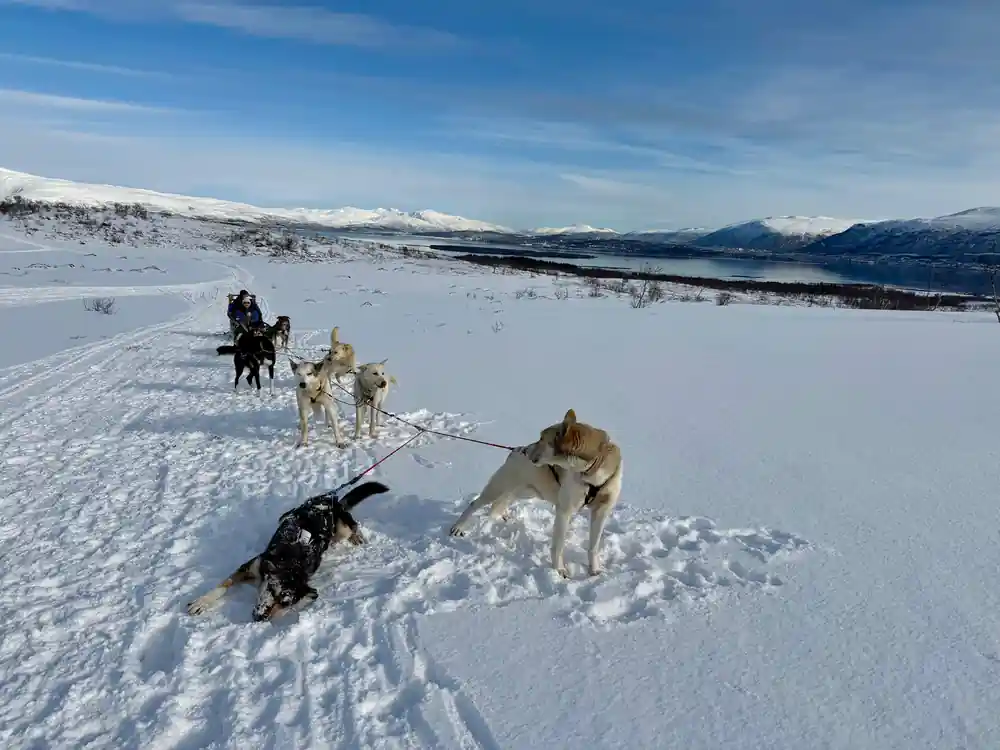
The centre sits on the island of Kvaløya, a short drive west of Tromsø's compact city centre. The route crosses bridges and climbs into low hills, where birch scrub gives way to open snowfields. The island is not the deep Arctic interior; it's a working landscape of small fishing villages and forested slopes. The kennel you visit is a real operation, home to many Alaskan huskies that pull sleds through the winter.[2] Open the van door and you hear the chorus before your boots touch the ground; a dozen tails beat against the sled boxes.
Tromsø itself, at 69°N, sits north of the Arctic Circle by 400 km.[7] That means the sun sits low in winter, and the light, when it comes, is a blue-and-pink glow that lasts only a few hours. The average winter temperature is around −4°C, but wind and driving snow can make it feel colder.[5] The trail conditions are carefully maintained, and the dogs know every bend. On a clear morning the snow sparkles; on a grey one the forest fades into soft monochrome, and the only colour is the red of a sled rope.
Close to the City, Not Inside It
You don't have to give up a whole day to reach the kennel. The tour lasts 4 hours, including the drive and the lunch.[1] That makes it easy to fit into a morning or afternoon, leaving time for a harbour walk or a visit to the Arctic Cathedral. But once you're at the camp, the city feels far away. The only sounds are the jingle of harnesses, the creak of the sled, and the dogs' excited yips as they wait to run. The coach is warm, the windows fog up, and the driver drops you at the gate; from there, the snow swallows the world.
The short travel time is a real advantage. You can book the tour knowing you'll be back in town before dark, or with enough light left to chase the northern lights in the evening.[6] The airport is also close, about 10-20 minutes from the city centre, so you could even arrive, head straight to the kennel, and still have a full afternoon.[8] A morning departure gives sharp trails and eager dogs; an afternoon start brings softer snow and a low golden sun.
Travelling with children? Ask the operator when you book whether younger ones can ride in the sled basket while adults take the runners. The kennel is a controlled, friendly place, but the dogs are working animals; teach little ones to approach slowly and let the dogs sniff first.
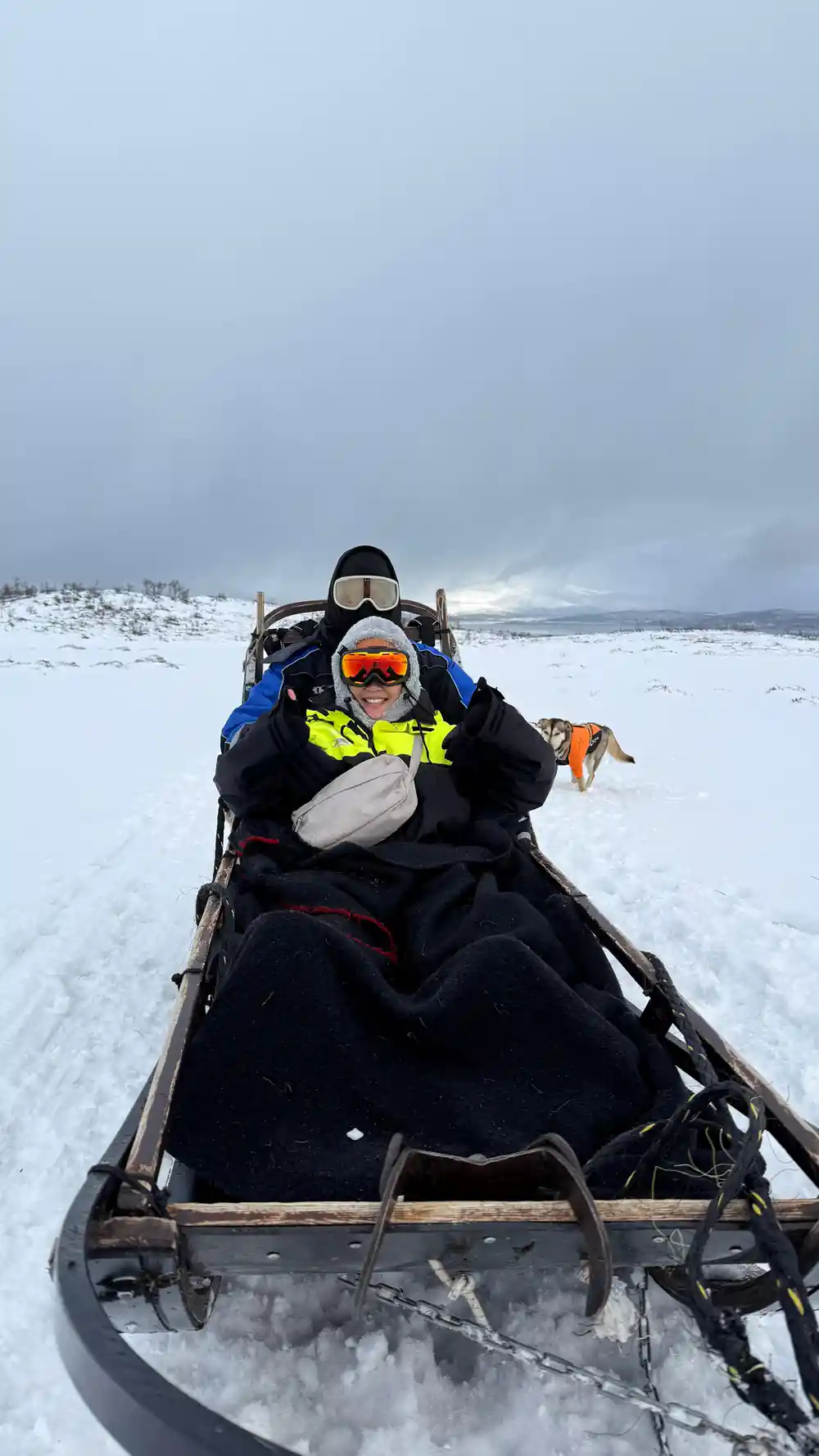
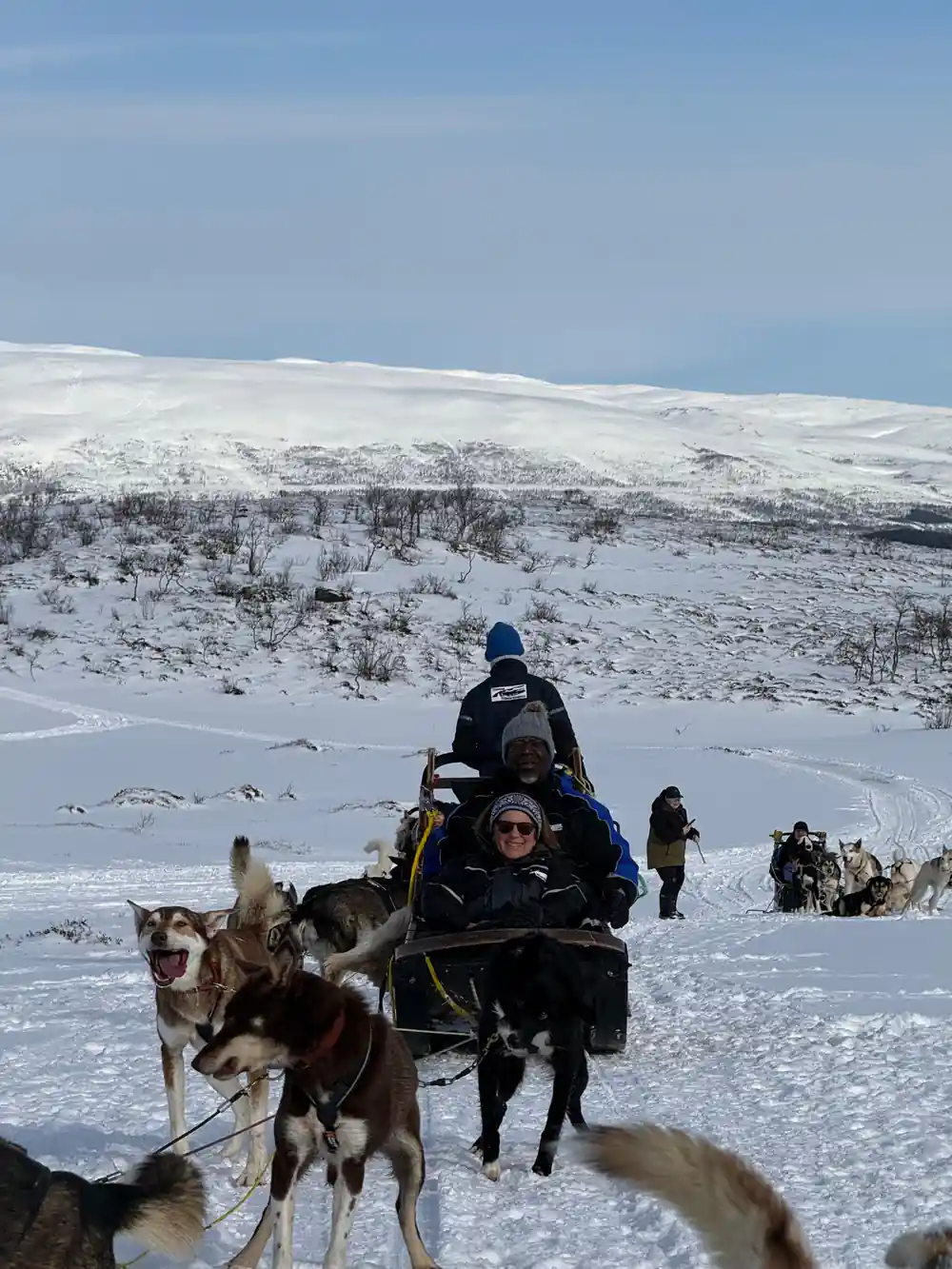
A musher on the runners, passenger tucked under the reindeer skin, crossing a snowy plateau.
Arriving at a Working Kennel
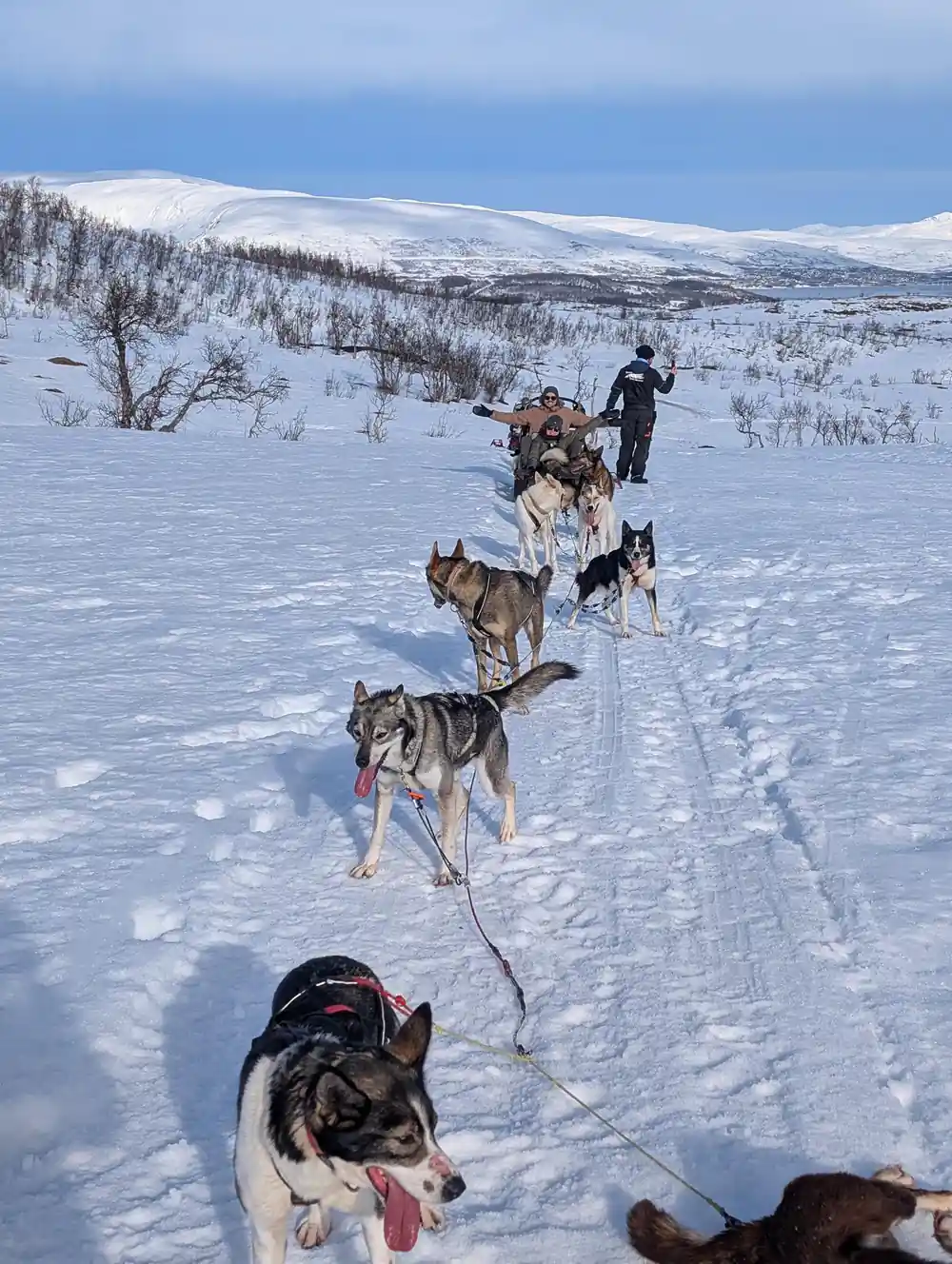
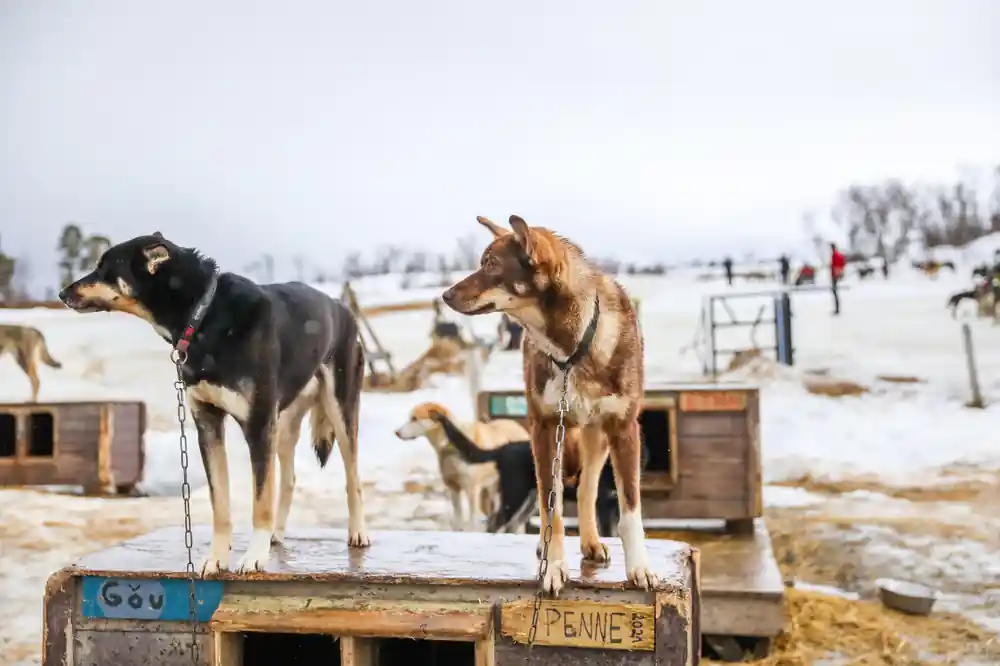
When the bus pulls into the yard, you'll hear the dogs before you see them. Rows of wooden boxes, each with a pair of bright eyes and a wagging tail, line the slope. This is not a petting zoo. It's a kennel where the animals are trained for racing and touring. Alaskan huskies are the breed of choice here, known for their stamina and drive.[2] The mushers move quickly, checking harnesses and hooking lines, and you'll be asked to help hold a sled or two. The air smells of straw, fur and wet snow; the dogs spin in tight circles when the harness bucket comes out.
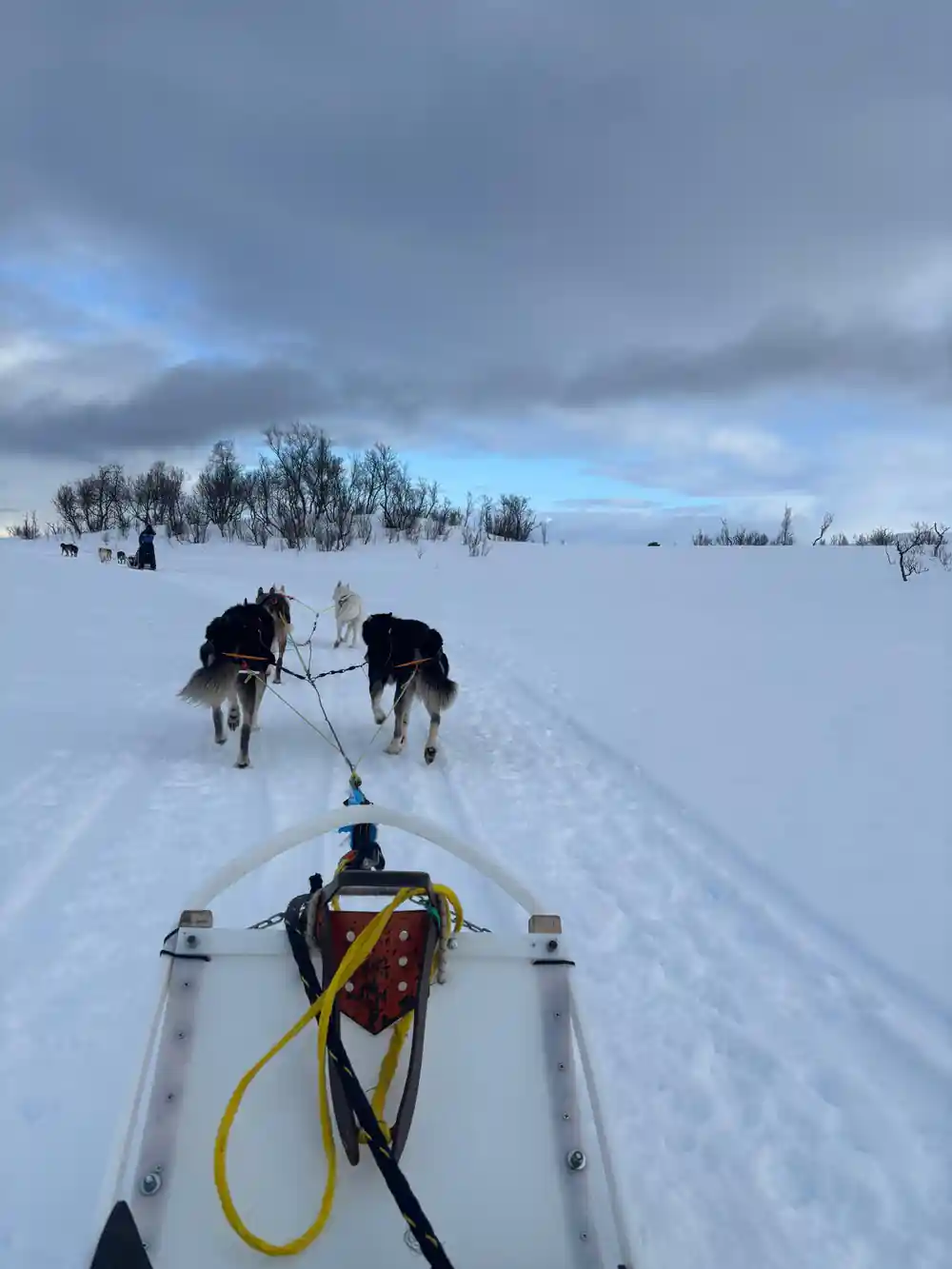
You'll receive a short briefing on how to stand on the runners, how to brake with the claw, and how to lean into turns. Then teams are drawn out, and the noise builds. When the first sled pulls away, you'll feel the power through your arms. The dogs are eager, and the silence of the forest is replaced by the rhythmic panting and the hiss of runners on packed snow. Hold the handlebar firmly and keep your knees soft; the trail will rock you more than you expect.
The Camp and the Gamme
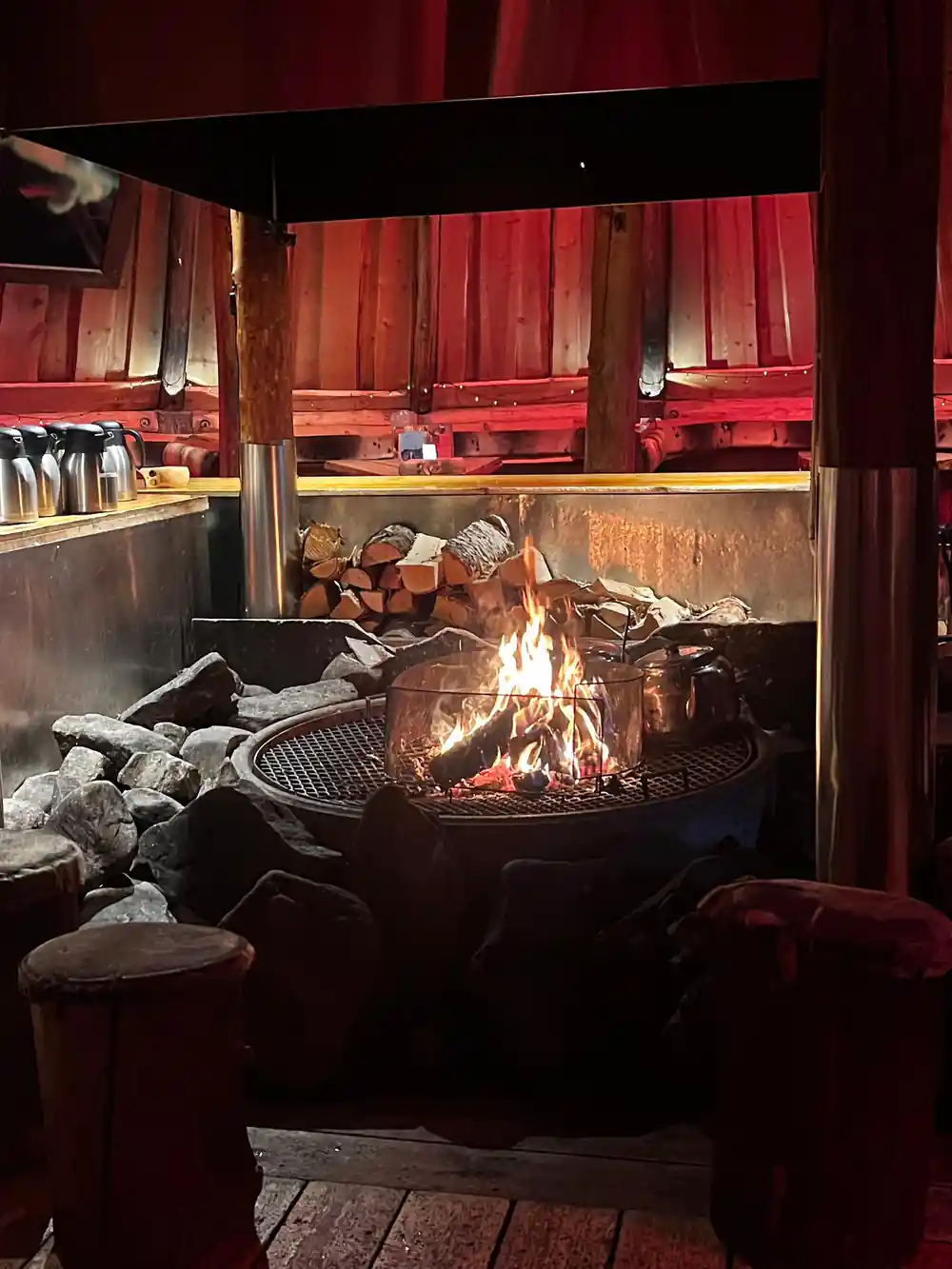
Halfway through or at the end, depending on the route, you'll be led into a gamme, a traditional turf-roofed hut. Inside, a wood stove crackles, and the air smells of birch smoke and stew. This is where the traditional lunch is served, a warm bowl of bidos, a reindeer stew, with bread and hot drinks.[1] The meal is simple but deeply satisfying after an hour on the runners. You'll sit close to the fire, sharing stories with the other mushers. Seconds are often offered, and nobody says no.
The gamme is not a polished restaurant. It's a functional shelter, used by the mushers themselves between runs. That's part of the charm. You'll see worn benches, a kettle on the stove, and perhaps a stack of frozen gloves drying near the fire. It gives you a glimpse into the working life of a dog sledding camp, far from the glassy tourist cafés in town. The windows steam over, and outside the dogs curl up in their straw, tails over noses.
from US$355
Self-drive husky sledding with a traditional lunch, 4 hours in the snow, guided in English. Free cancellation up to 24 hours.[1]
Arriving in the Dark, or the Blue Midday Light
In the deep winter, you'll likely arrive before the sun has climbed above the horizon, or after it has already set. Polar night runs roughly 27 November through 15 January, and days remain short even beyond those dates.[9] The light during the tour can be a deep blue twilight, with the mountains as dark silhouettes. Your guide will know the trails well enough to keep you safe, and the dogs don't care about the hour. Headlamps on the sled are standard, and the trail markers catch the beam like small mirrors.
If you come later in the season, you'll get more daylight, sometimes a soft golden glow on the snow. The trails will be well packed, and the temperature may be more forgiving. Either way, the experience of standing on a sled, pulled by a team of dogs, is the same. It's a little like flying low over the snow, the trees sliding by, the cold air stinging your cheeks. The runners hiss, the harnesses creak; you learn to read the trail by sound as much as by sight.
Neither Wilderness Nor a Show
Some visitors expect a rugged, untamed adventure. Others imagine a staged performance for tourists. The reality sits between the two. The kennel is a working operation, but it's set up to receive guests safely. You're not dropped into the deep backcountry; you follow groomed trails with a guide nearby. That's wise. An untrained handler in unknown terrain can be dangerous. Yet the woods are wild enough: branches click with frost, and the quiet is enormous once the dogs stop.
The dogs, however, are the real thing. They live for the run, and their enthusiasm is contagious. You'll see the bond between musher and dog, the careful way they check each animal's feet, the proud way they point at a leader. The centre is a gateway to that world, not a simulation. If you've ever wondered what it feels like to command a sled dog team, this is your chance. You'll leave with snow in your cuffs, pine needles in your pockets, and the sound of barking in your ears.
Planning Your Trip
Book the tour for the morning if you want the calmest trails, or the afternoon if you prefer softer snow. The tour runs from November to April, and snow conditions can shift quickly.[2] Dress in layers: a thermal base, a fleece, and a windproof shell. Your own boots matter most. You'll be standing on a sled for long stretches, so they should be insulated and waterproof. A warm hat and thin gloves under mittens let you handle buckles without freezing.
Bring a camera, but keep it in a pocket until you stop. Steering takes both hands, and a dropped phone or glove can be lost in the snow. Listen carefully to the safety briefing, and don't be shy about asking questions. The guides are proud of their dogs and happy to share stories. After the trip, you'll leave with a new respect for the sport, and maybe a few adopted dogs in your heart. If you can, sit facing forward on the ride back and watch the kennel shrink to a dark speck on the white hillside.
Rated by guests
Compare Husky Tours
US$ from-prices of the three GetYourGuide husky tours:[1],[3],[4].
When to Book
How to Book This Tour
Reserve Online
Choose your date and check availability. You can reserve now and pay later,[1] so no risk if plans change.
Prepare for the Cold
Dress in layers and wear waterproof boots. The average winter temperature is around −4°C.[5]
Arrive at the Kennel
Make your way to the departure point in Tromsø or drive to the kennel. The tour lasts 4 hours.[1]
Learn the Basics
Your guide gives a brief lesson on braking, leaning, and controlling the sled. Ask questions before you set off.
Run the Trails
Drive your own team over packed snow, with the guide nearby. Expect the dogs to be eager and fast.
Warm Up with Lunch
After the run, enjoy a traditional lunch in a gamme hut, often a reindeer stew like bidos.[1]
Ready to Drive Your Own Huskies? Secure Your Spot Now
from US$356Reserve now & pay later